Microsoft Power Platform, Copilot Studio, Dataverse, Power Automate, Microsoft Teams, SharePoint and Word Templates
1 parent orchestration agent · 1 connected specialist agent · 2 child agents · 7 core Dataverse tables · 8+ Power Automate flows
Copilot Studio
Automate
Dataverse
Teams
Word Template
SharePoint
Power Apps
AI Builder
Engagement Hub was awarded second place in the Operative Track — recognised for a practical, governed AI-agent solution built on Microsoft Copilot Studio and Power Platform.
The submission combined multi-agent orchestration, Dataverse, Power Automate, Teams notifications, SharePoint and Word document generation into a single end-to-end business process.
The recognition reflects a focus that runs through all my work: designing real-world Microsoft AI and automation solutions with enterprise-style architecture, governance and human review built in.
Client requests often arrive as unstructured briefs, documents and emails. That makes them slow to triage, difficult to risk-assess, and hard to route consistently to the right service offering or delivery team.
In a consultancy setting, this carries real operational cost. Important details get missed, risks surface too late, duplicate engagement records accumulate, and delivery teams inherit incomplete handoffs. Human review remains essential — but teams need a faster, more traceable path from client submission to delivery preparation.
Engagement Hub is a governed client intake and delivery-prep system built with Copilot Studio, Power Automate and Dataverse.
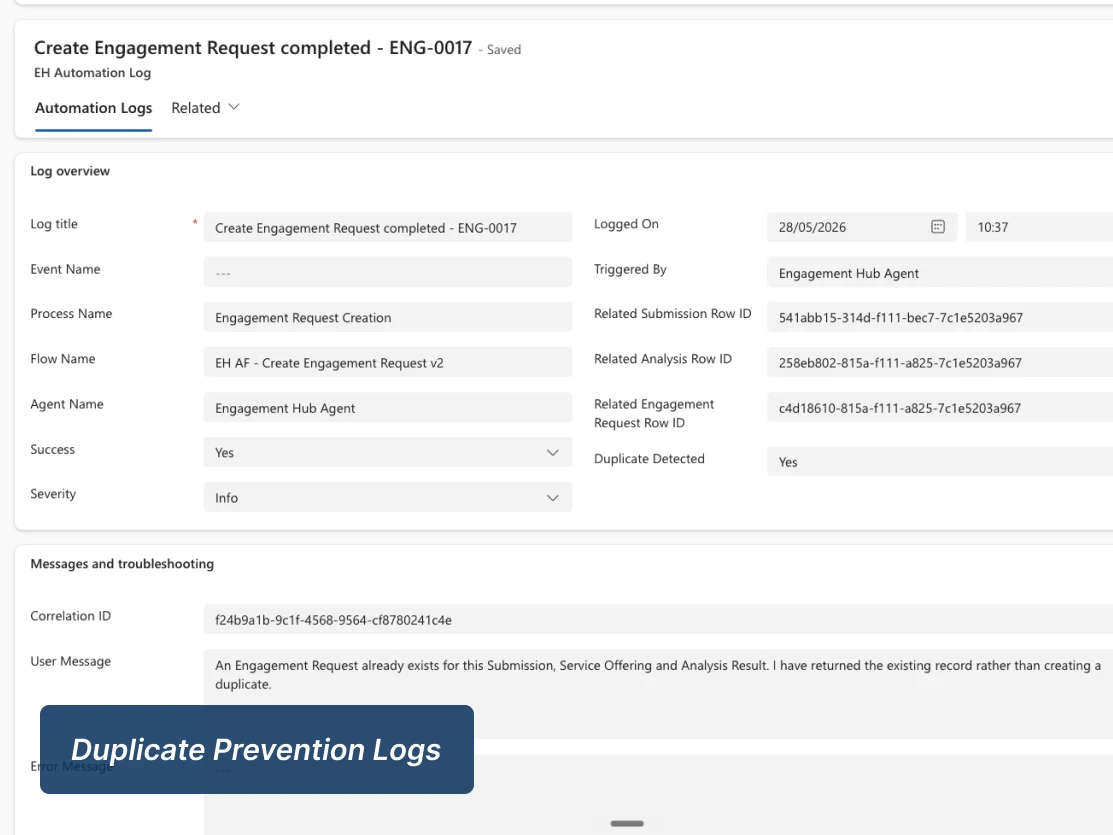
It begins by analysing a submitted client document, extracting key risks and missing information, and storing that analysis in Dataverse. Before any record is created, it asks the user to confirm — and if a matching request already exists, it returns that record rather than creating a duplicate.
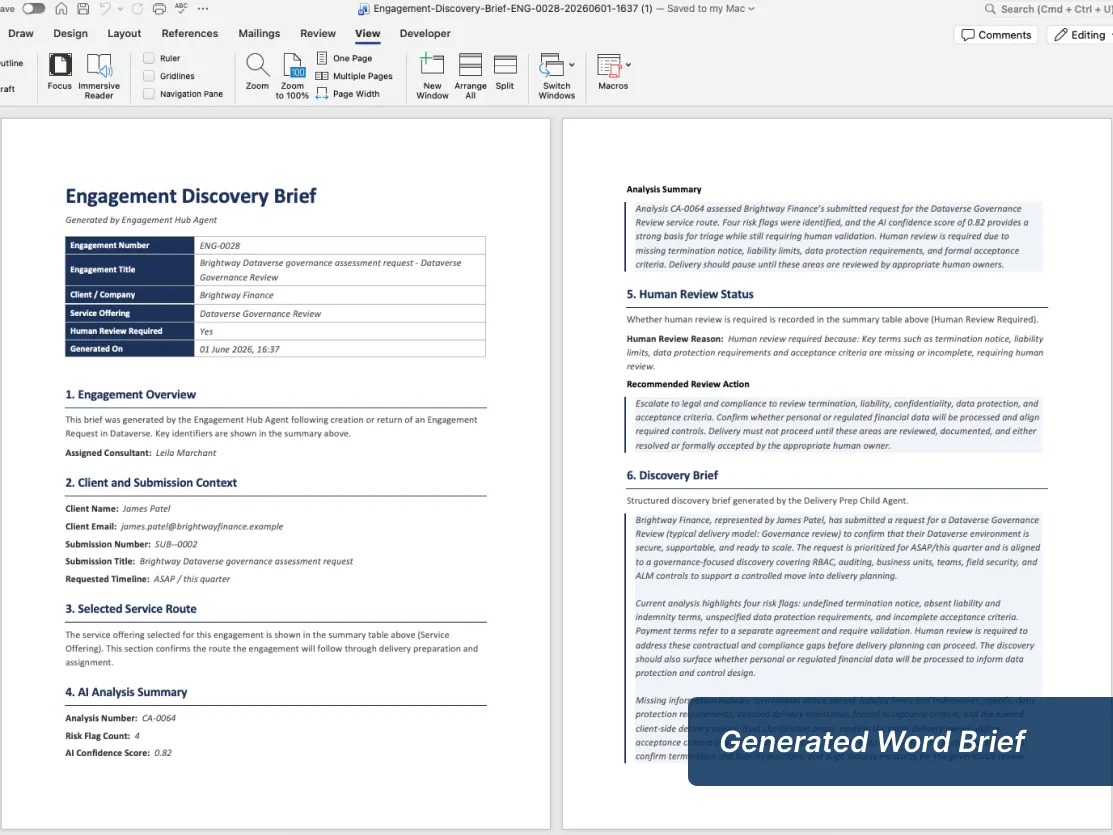
Once an Engagement Request exists, the user can hand off to the Delivery Prep Child Agent. The system generates a structured discovery brief, saves it back to Dataverse, produces a Word handoff document in SharePoint, and posts a Teams notification when human review is required.
Every significant step is written to an Automation Log with a correlation ID, success or failure status, and a user-facing message — so the process is auditable, not just conversational.
Engagement Hub uses a multi-agent architecture built around a Dataverse system of record.
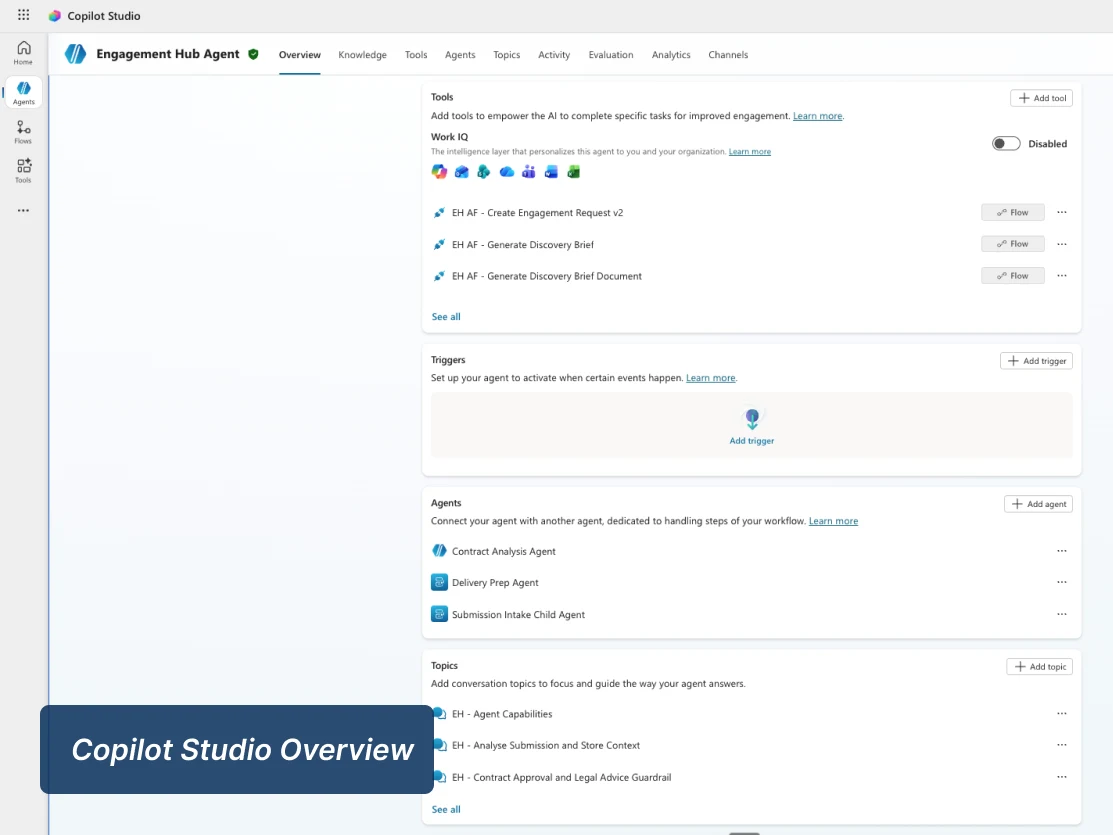
A parent Engagement Hub Agent orchestrates the process, delegating defined parts of the workflow to specialist agents. The Contract Analysis Agent reviews submitted commercial documents, and the Delivery Prep Child Agent prepares downstream discovery and handoff material.
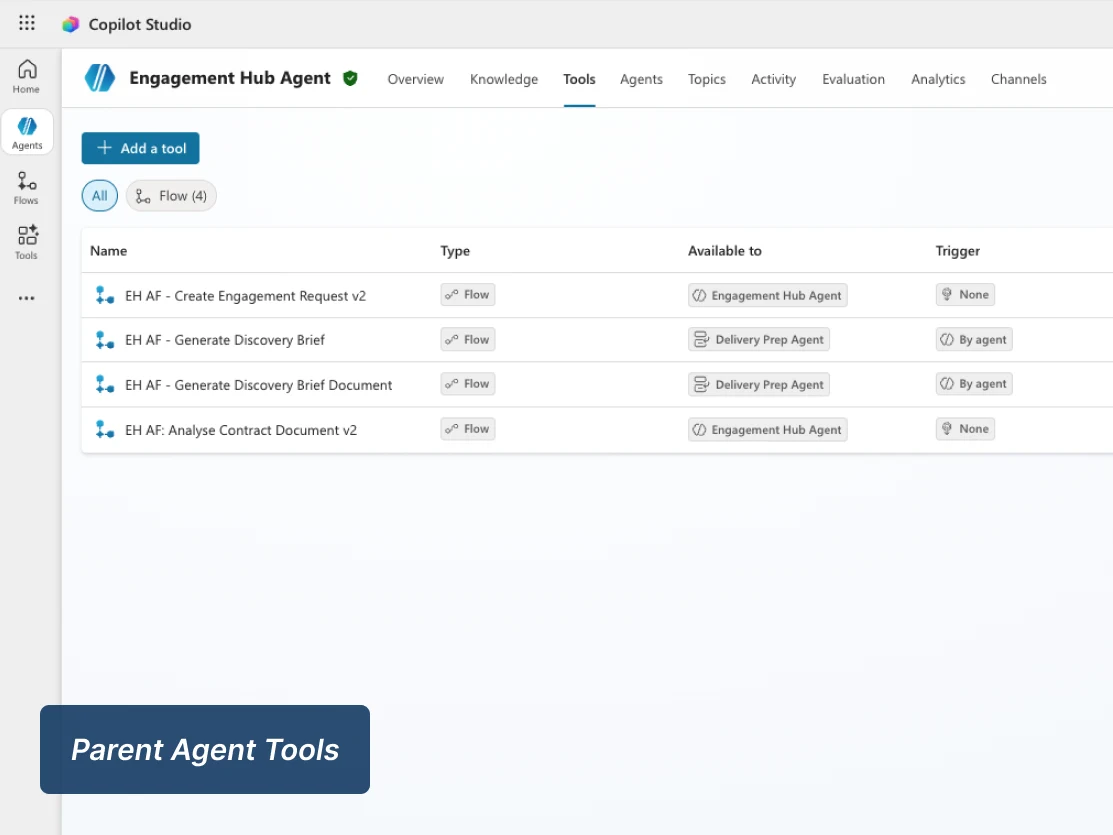
Power Automate handles the deterministic work: retrieving Dataverse records, running AI prompts, parsing structured outputs, creating or returning Engagement Requests, generating Word documents, posting Teams notifications and writing Automation Logs.
The design deliberately separates conversational control from reliable backend automation. Users interact through Copilot Studio, while Dataverse holds the operational records, relationships, review status, generated outputs and traceability data — keeping the reasoning layer and the system of record decoupled.
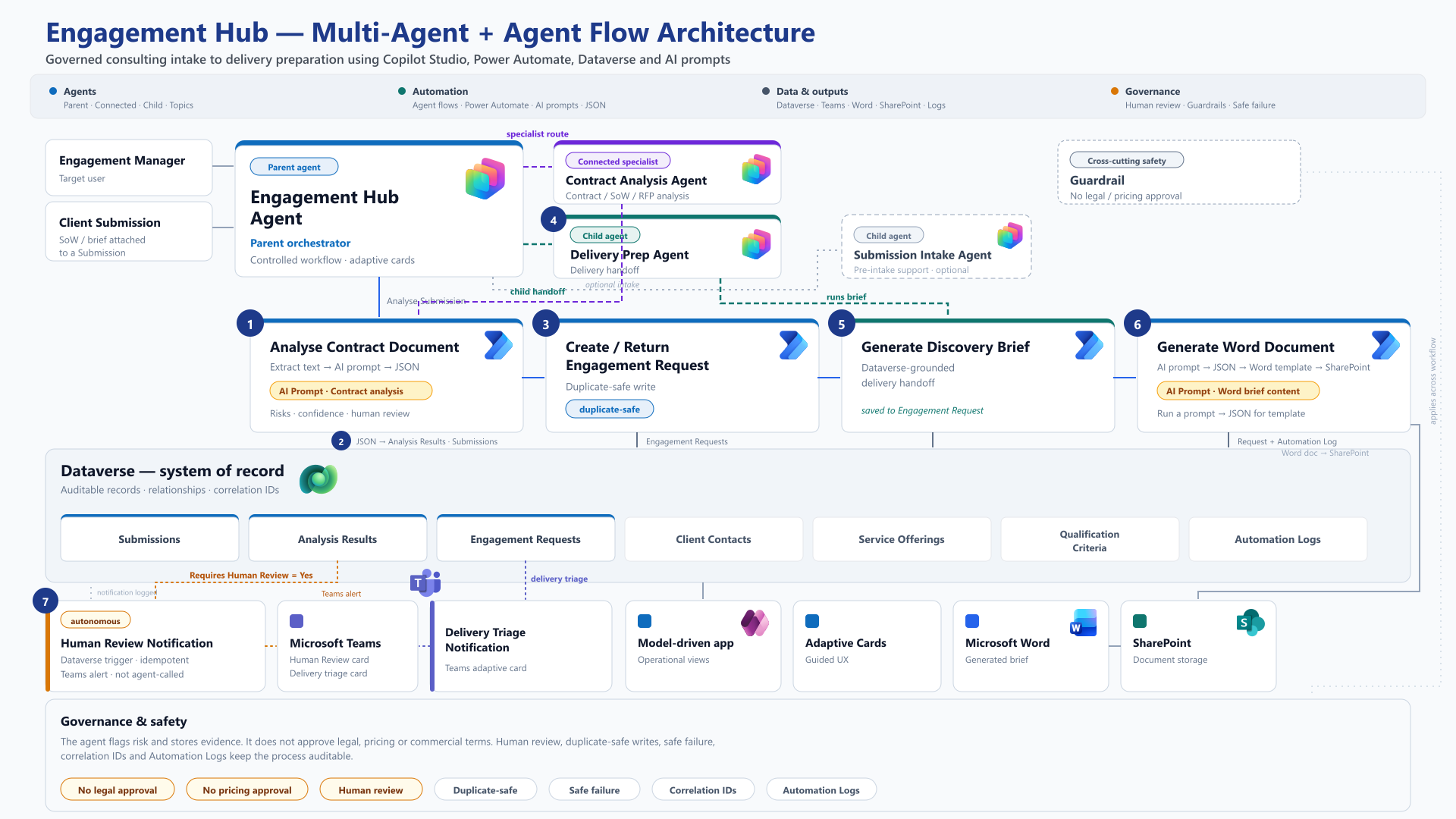
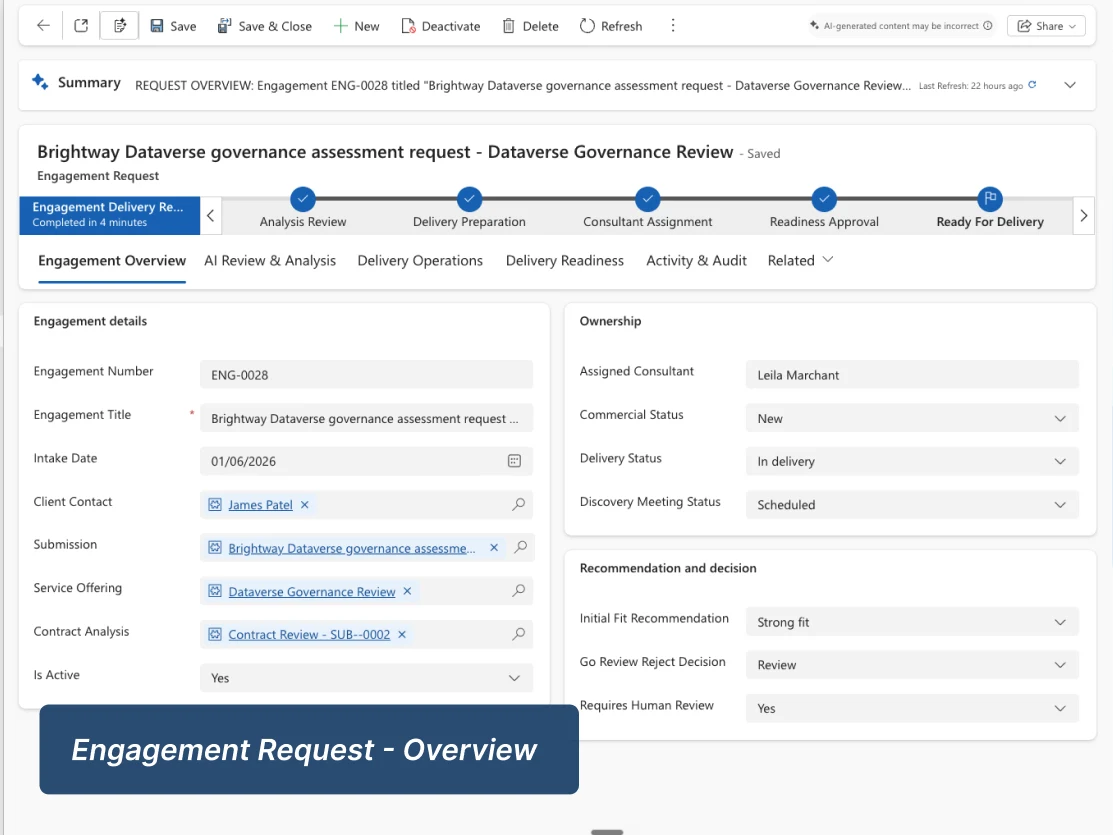
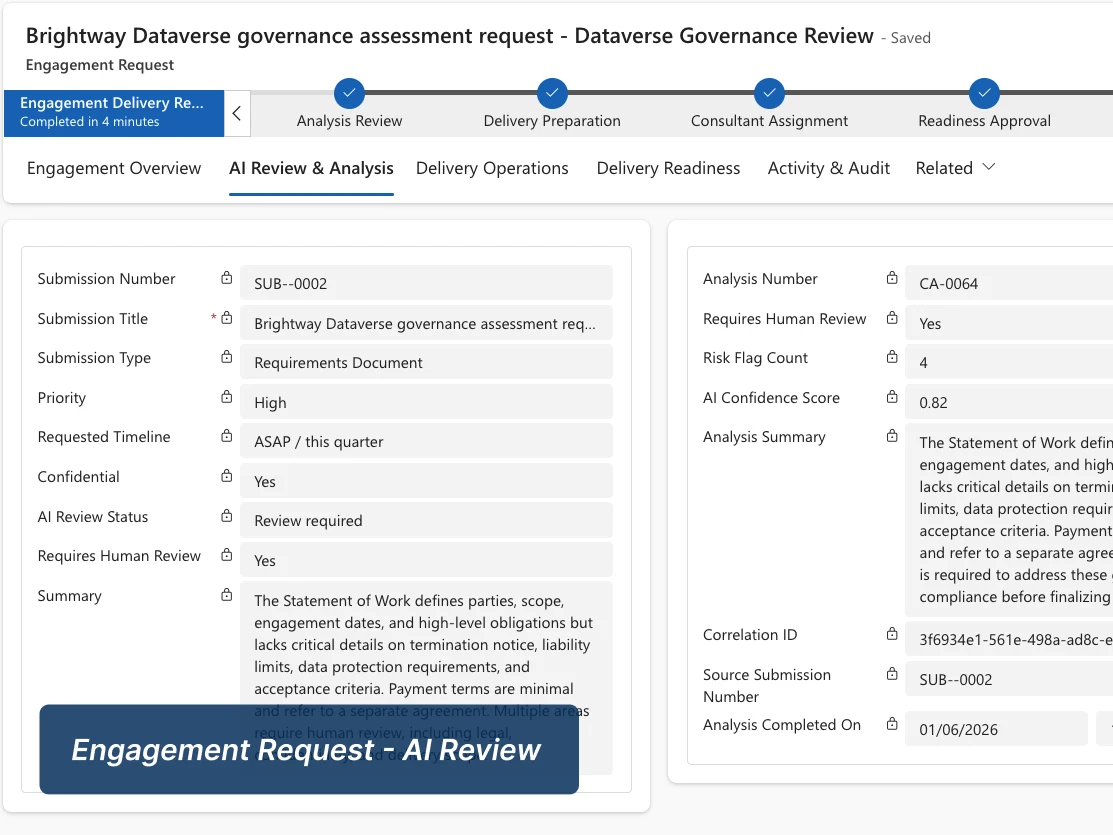
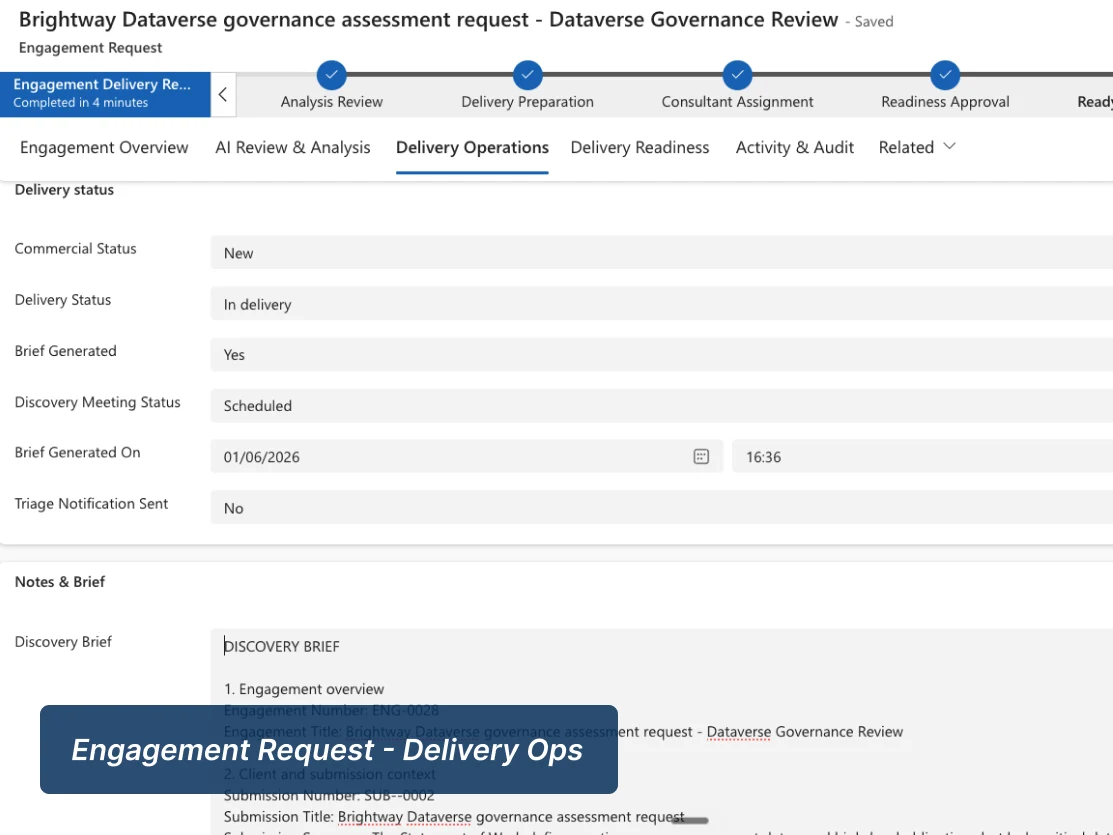
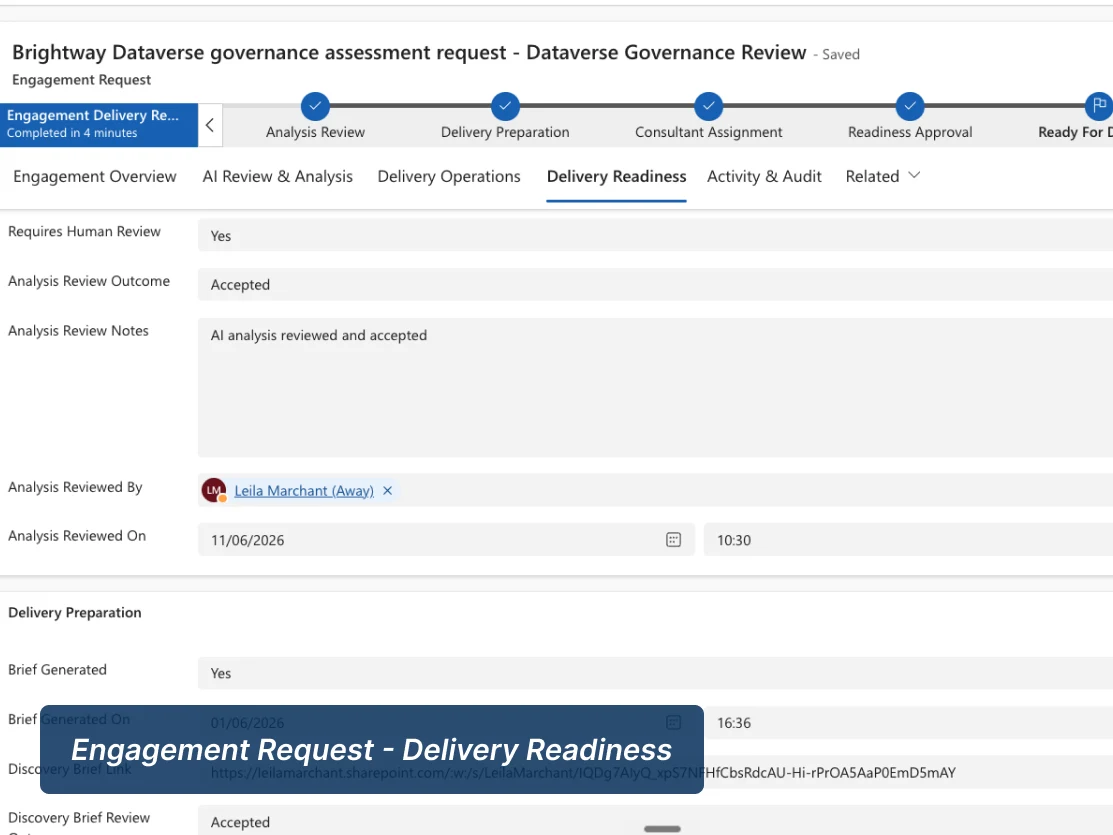
These screenshots show the controlled workflow behind Engagement Hub — from document analysis through duplicate-safe Engagement Request creation, delivery handoff, Word document generation and human-review notification.
Each agent action is backed by Power Automate, Dataverse records and Automation Logs, so the process is traceable rather than just conversational.
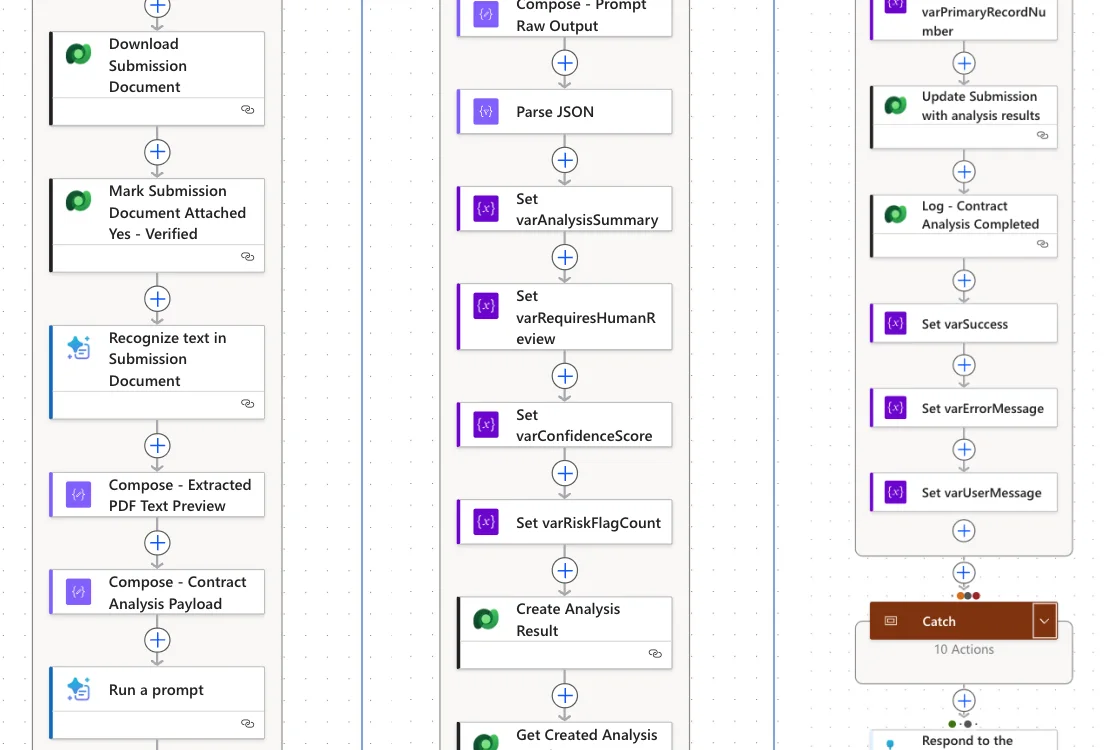
The contract analysis flow retrieves the client submission, extracts the document text, runs the document-analysis prompt, parses the structured JSON result and writes the analysis back to Dataverse. Each run captures risk flags, information gaps, a confidence score, the human-review recommendation and a correlation ID for traceability.
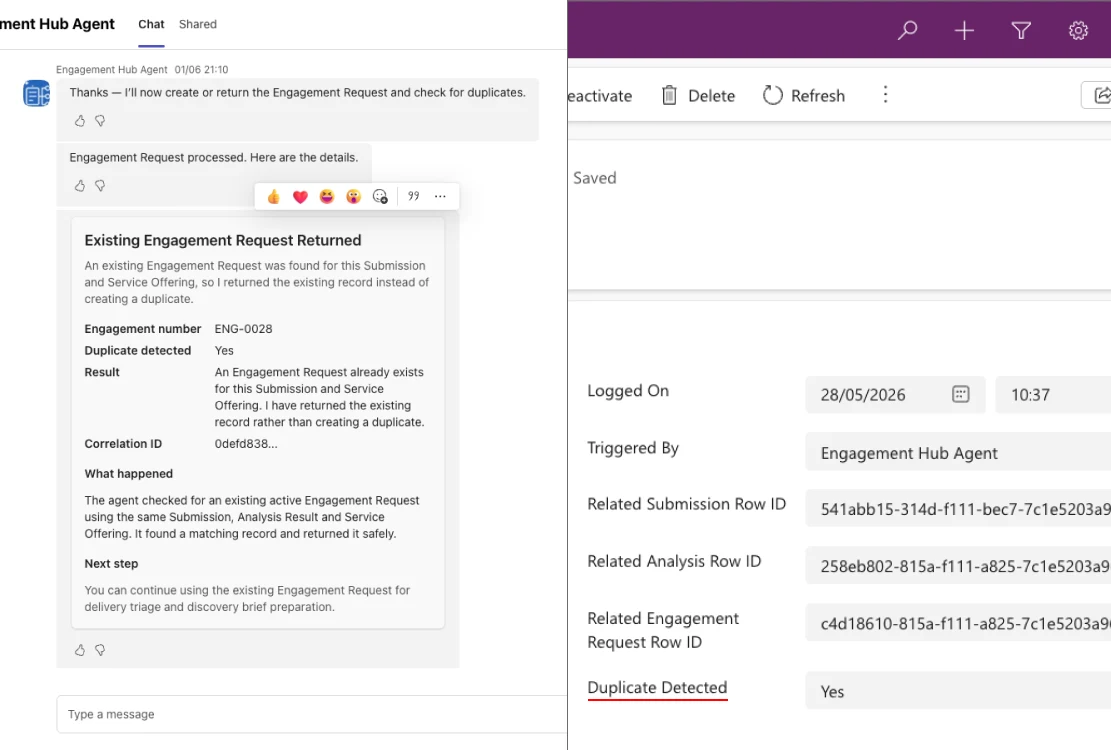
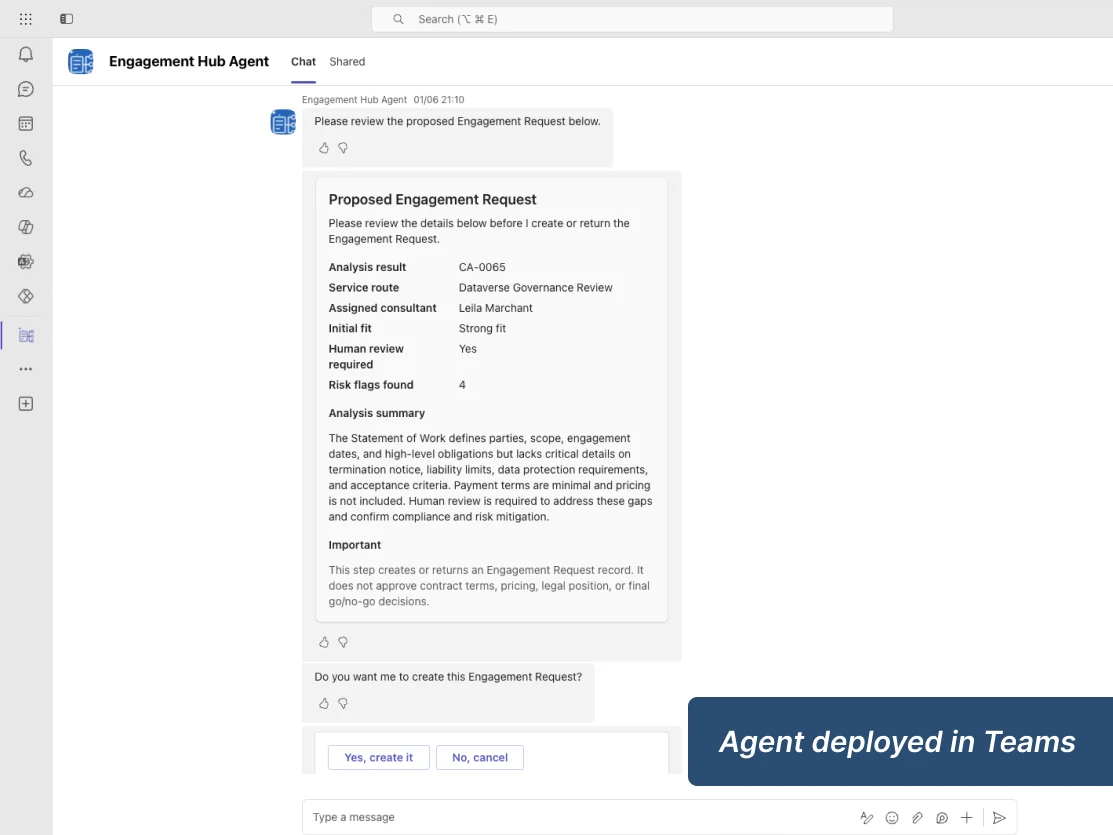
The agent asks for confirmation before creating an Engagement Request. The flow checks for an existing matching request first, returning the existing record instead of creating a duplicate and treating duplicate prevention as a successful, governed outcome.
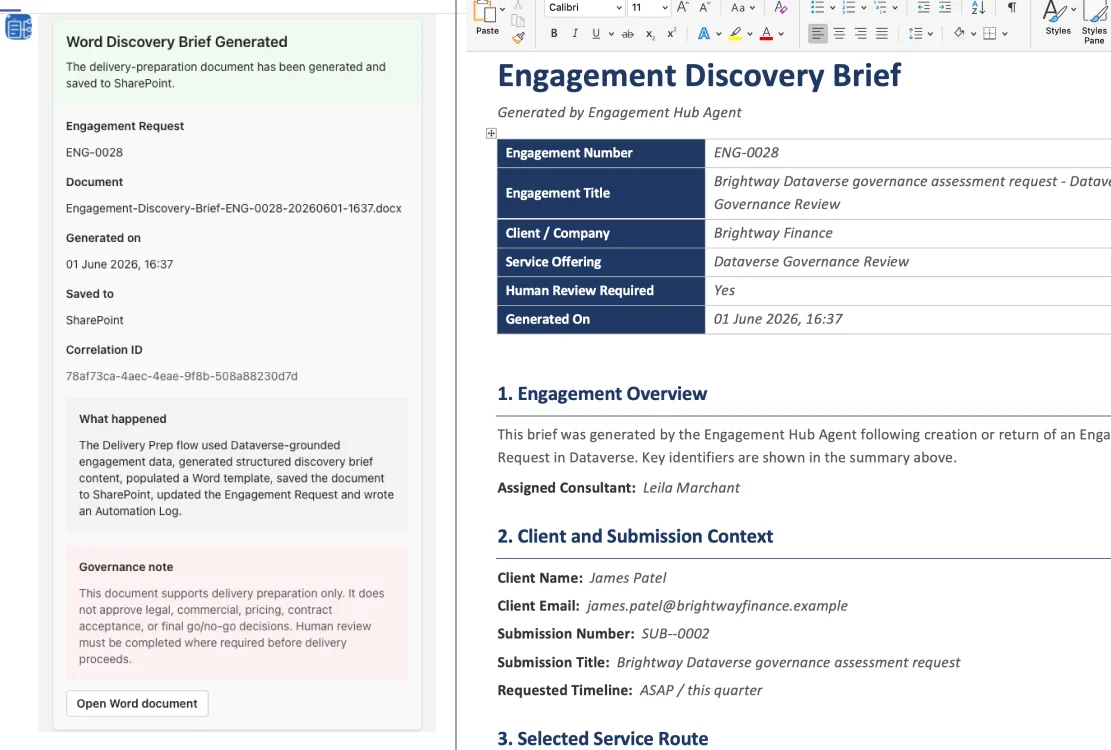
The parent agent hands work to the Delivery Prep child agent to create a discovery brief. The system saves the brief to Dataverse, generates a Word handoff document from a template, stores it in SharePoint and returns a link to the user.
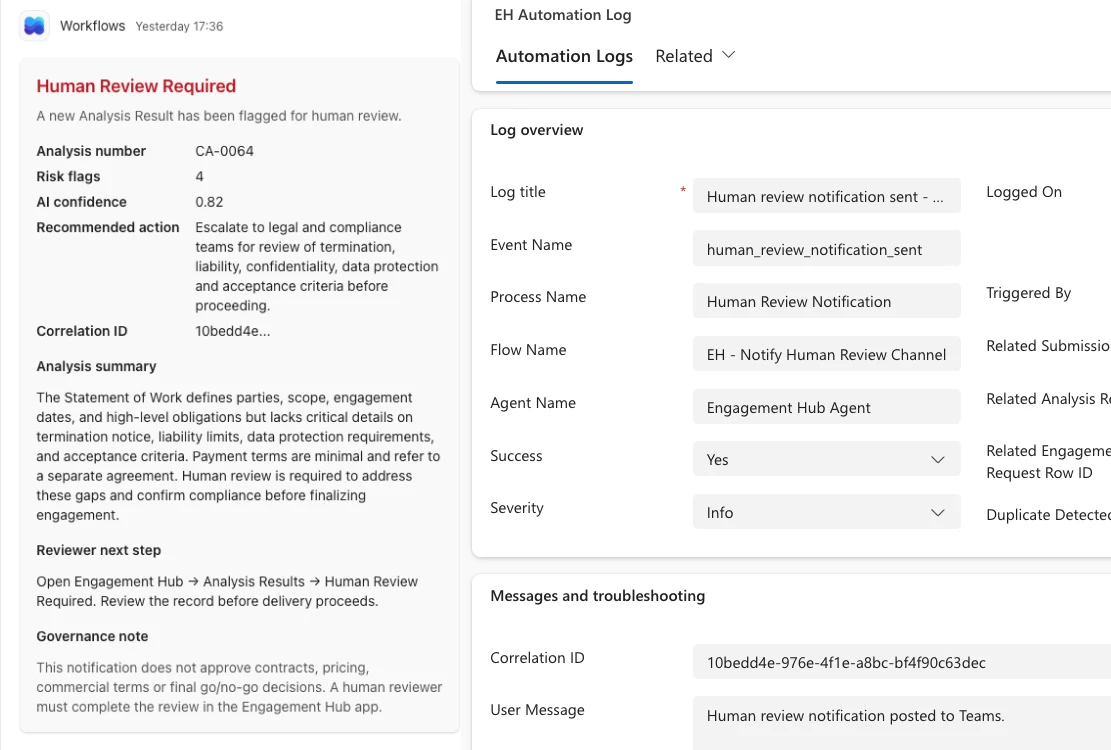
When human review is required, a standalone flow posts a Teams adaptive card to alert the reviewer. The notification is logged in the Automation Log, with duplicate-prevention logic to avoid repeated alerts for the same Analysis Result.
Engagement Hub is built to prepare evidence, route work and produce traceable delivery outputs — not to make legal, commercial or final go/no-go calls. Its findings are stored as structured operational data for a person to review: the system surfaces and recommends, but the decisions that carry risk stay with the consultant.
Bounded AI role: The agent can extract risks, identify gaps and recommend review, but cannot approve contract terms, pricing, commercial decisions or final delivery readiness.
Human confirmation before record creation: The user reviews the proposed service route, consultant and fit recommendation before an Engagement Request is written to Dataverse.
Controlled versus autonomous handoffs: Delivery preparation uses a conversational handoff so the consultant stays in control. Risk escalation uses an autonomous Teams notification when immediate review is needed.
Duplicate-safe business actions: Engagement Request creation checks the existing business context before writing a new record. Matching requests are returned rather than duplicated.
Dataverse as the system of record: Submissions, Analysis Results, Engagement Requests, delivery briefs and review status remain connected through Dataverse relationships.
Automation Log audit trail: Major workflow actions record status, related records, agent and flow names, user-facing messages and correlation IDs.
Idempotent human-review alerts: Before posting to Teams, the notification flow checks for a previous successful alert for the same Analysis Result, preventing repeated reviewer notifications.
Safe failure paths: Missing documents, invalid Engagement references and unexpected flow failures stop the process safely. The system avoids partial downstream records and returns a traceable failure outcome.
This project demonstrates how I design multi-agent Power Platform solutions that combine AI-assisted reasoning with human control, deterministic automation and operational traceability.
A parent agent orchestrates specialist analysis and delivery-prep agents.
Deterministic flows retrieve, create, update, notify, and log records safely.
Connected intake, analysis, engagement, delivery, and audit data.
Delivery prep runs through a deliberate conversational handoff rather than an automatic trigger, so a consultant chooses when downstream work begins.
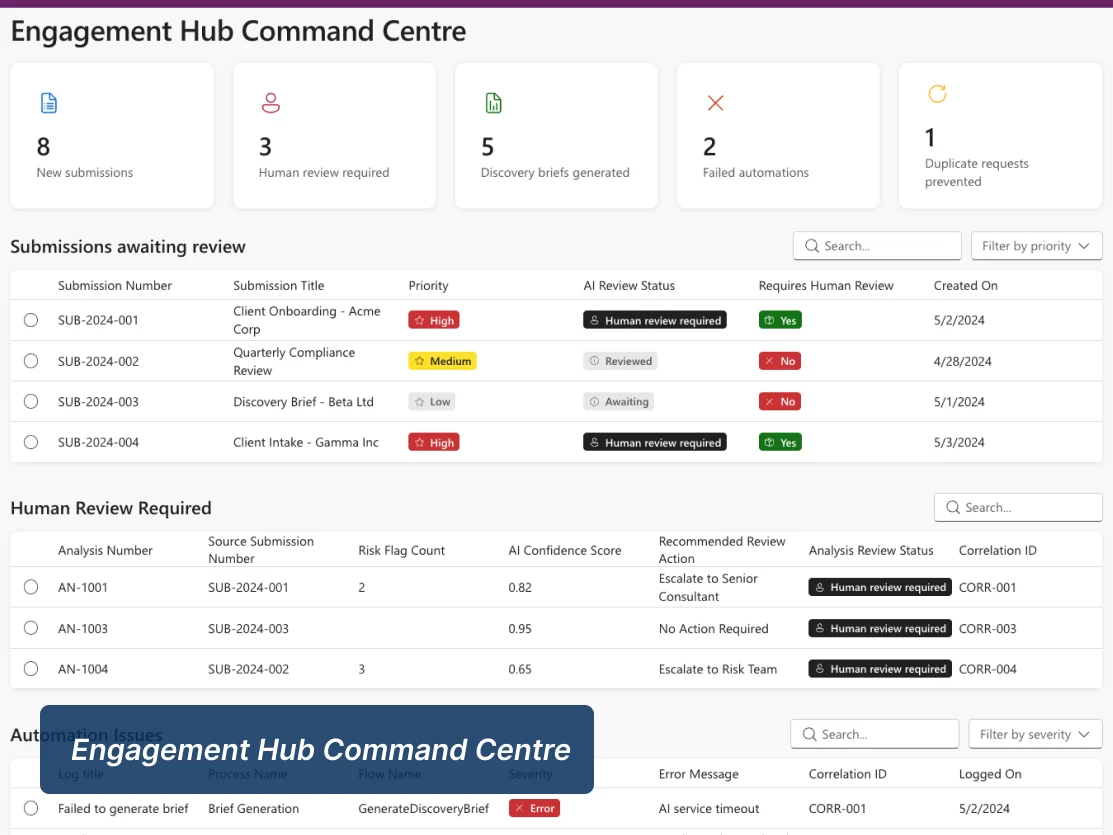
A model-driven app makes triage, review, delivery prep, and records visible.
Duplicate-safe writes, idempotent alerts, correlation IDs, and audit logs.
Building Engagement Hub reinforced that stronger agent systems do not come from adding more AI. They come from defining clear boundaries around what AI can recommend, what people must decide, and what automation can safely complete.The user journey needed to feel simple, but that simplicity depended on deliberate structure behind the scenes: a connected data model, controlled handoffs, duplicate-safe actions, clear failure paths and visible audit evidence. The result is a more trustworthy system because it does not hide operational complexity — it manages it.
The current build is deliberately scoped as a portfolio-ready demonstration — but the data model, controlled agent flows and audit trail are production-shaped, so extending it is additive rather than a rebuild.
The next phases would expand how requests enter the service, how human review is managed and how the solution is governed at scale.
Connect a secure request form, shared mailbox and Teams entry point to create Submissions automatically, resolve client contacts and start the governed analysis workflow.
Add reviewer assignment, decision statuses, approval actions and time-based escalation so high-risk findings have a clear owner and cannot progress unnoticed.
Introduce role-based access, environment-aware deployment pipelines, monitoring and operational dashboards to support controlled releases and continuous improvement.
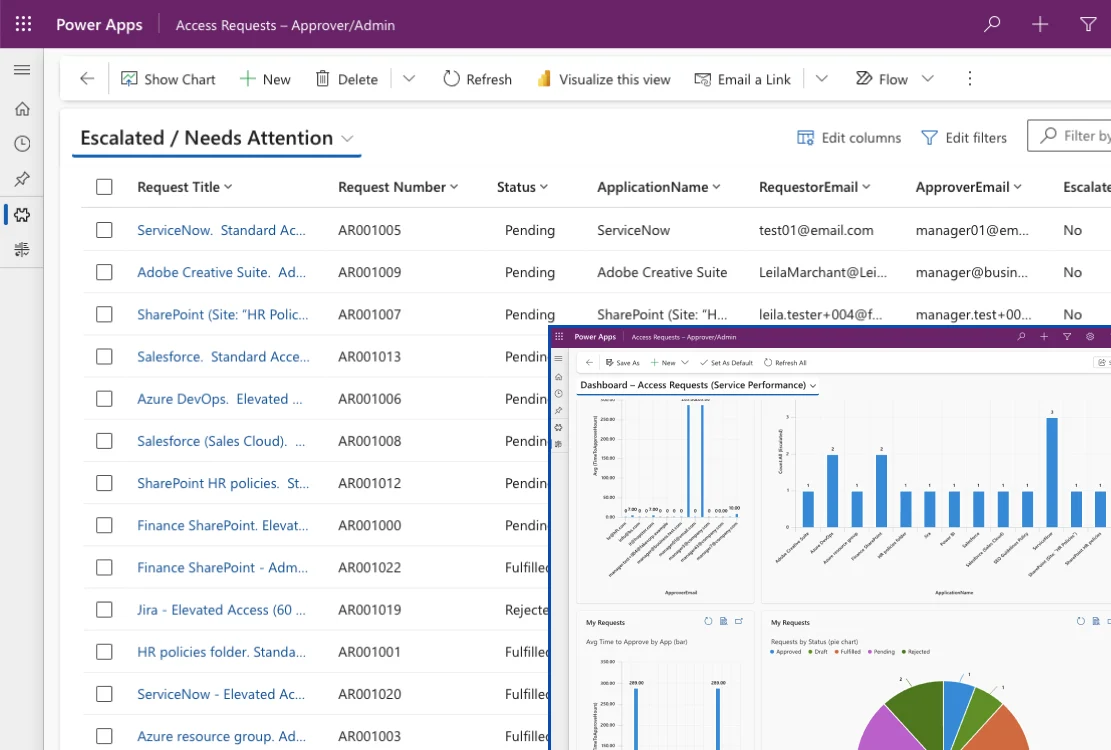
See how I applied the same Power Platform approach to access governance, combining conversational intake, approval routing, identity-aware controls and Dataverse-backed lifecycle visibility.